

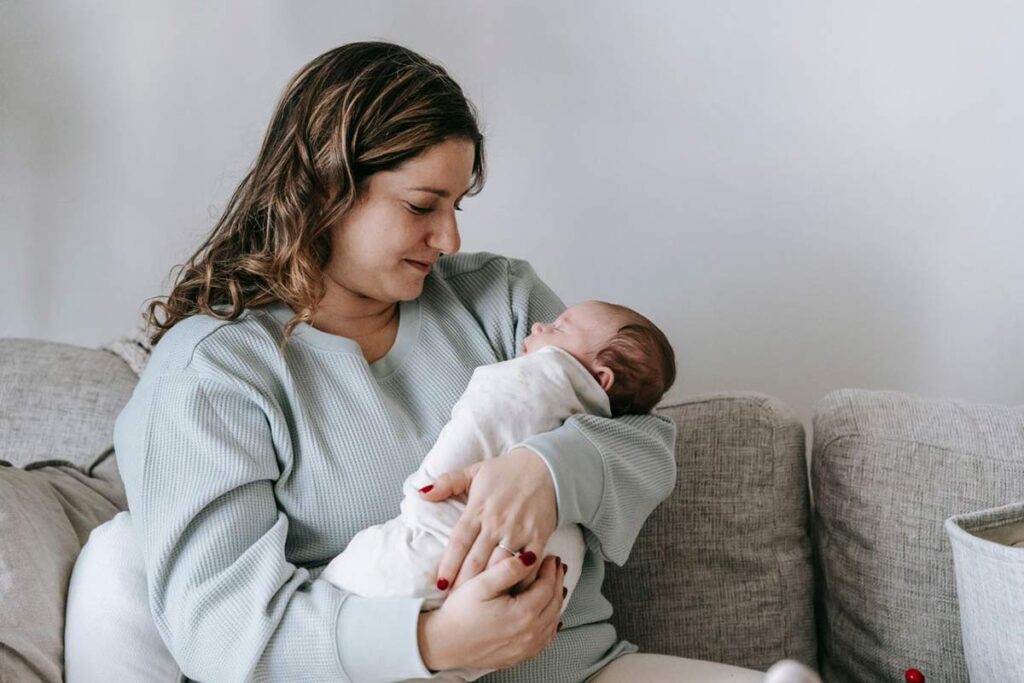
You finally get your newborn to sleep against your chest. Their breathing slows, their tiny fist relaxes, and you wait another five minutes just to be safe.
Then you lower them into the bassinet.
Eyes open. Legs kick. Crying starts.
If this happens over and over, you may begin to wonder whether holding your baby so often is creating the problem. For a young newborn, wanting closeness is usually not a bad habit. It is part of being very new to the world.
Photo by Sarah Chai on Pexels
Why Does My Newborn Want to Be Held Constantly?
Inside the womb, your baby experienced warmth, movement, pressure, your heartbeat, and very little time completely alone.
After birth, being put down can feel like a dramatic change. Your arms provide warmth, motion, familiar smells, and the rhythm of your breathing, all at once.
That same need for warmth and closeness is one reason skin-to-skin contact with your newborn can feel so calming in the early days.
There are practical reasons too. A newborn may ask to be held more when hungry, overtired, gassy, overstimulated, going through a growth spurt, or simply needing help settling.
Wanting your body nearby is communication, not manipulation.
Can You Spoil a Newborn by Holding Them Too Much?
This is one of the most persistent newborn myths.
The American Academy of Pediatrics advises parents to respond promptly to crying during the first few months and states that you cannot spoil a young baby with attention. Responsive care helps a baby learn that someone will come when they need help.
That does not mean you must hold your baby every second of the day. It means comforting a newborn is not teaching them to control you.
A baby this young is not planning ahead. They are signaling discomfort, hunger, tiredness, or a need for closeness.
What This Looks Like in Real Life
Pediatricians hear this complaint constantly.
Daniel Ganjian, MD, a pediatrician at Providence Saint John’s Health Center, describes parents reporting that during particularly fussy periods they feel as though they “can’t put their babies down.” Some babies want to be held almost continuously, while feeding and sleep patterns may also change for a while.
Picture 6 p.m. You have eaten half your dinner standing up because the baby settles only on your shoulder.
That does not automatically mean anything is wrong.
Why Does My Baby Cry the Moment I Put Them Down?
Sometimes the transfer itself wakes them. Your body is warm and moving; the bassinet is still and comparatively cool.
Other times, the baby was never deeply settled in the first place.
Crying also naturally increases during the early weeks. Mayo Clinic notes that crying commonly peaks around six weeks of age before gradually decreasing.
So a suddenly clingier period may reflect development rather than something you caused.
What Can Help When You Need Your Hands Back?
You do not have to choose between holding your baby all day and ignoring their cries.
Try rotating simple strategies:
- feed and burp them if needed,
- check the diaper and clothing temperature,
- use gentle rocking or walking,
- reduce lights and noise if they seem overstimulated,
- let another trusted caregiver take a turn,
- place the baby safely on their back in the bassinet when you need a break.
Babywearing can also be useful once you have a carrier appropriate for your baby’s age and size and you know how to position the airway safely.
Comforting your baby and protecting your own energy can exist at the same time.
Holding Is Not the Same as Safe Sleep
This distinction matters.
A newborn may sleep beautifully in your arms, but if you are becoming sleepy yourself, the safest move is to place the baby in an appropriate sleep space rather than risk falling asleep together on a sofa, armchair, or adult bed.
Closeness is valuable. Safe sleep still comes first.
When Constant Crying Needs More Than Comfort
Most clinginess is normal, but “wants to be held” should not become an explanation for every change in behavior.
Seek medical advice promptly if your newborn has a fever, is unusually hard to wake, feeds much less than usual, has trouble breathing, vomits repeatedly, seems weak, or looks markedly different from their normal self. The AAP also advises urgent assessment for unexplained nonstop crying lasting more than two hours when the baby cannot be consoled.
For a baby under three months, a temperature of 100.4°F (38°C) or higher needs prompt medical evaluation.
If your newborn seems happiest in your arms, our guide to the best baby carriers for newborns compares several options designed to make everyday carrying more practical.
Final Thoughts
Your newborn wanting to be held does not mean you have started a bad habit.
In these early weeks, your arms are often the easiest place for a baby to regulate, settle, and feel secure. Independence comes later; newbornhood is not a test of how quickly a baby can manage without you.
Hold them when you can. Share the load when you need to.
Did your newborn seem happiest only when being held?
Tell us what helped your baby settle and which part of those early weeks felt hardest for you.
Your experience may help another new mom feel less alone during a very demanding stage.