

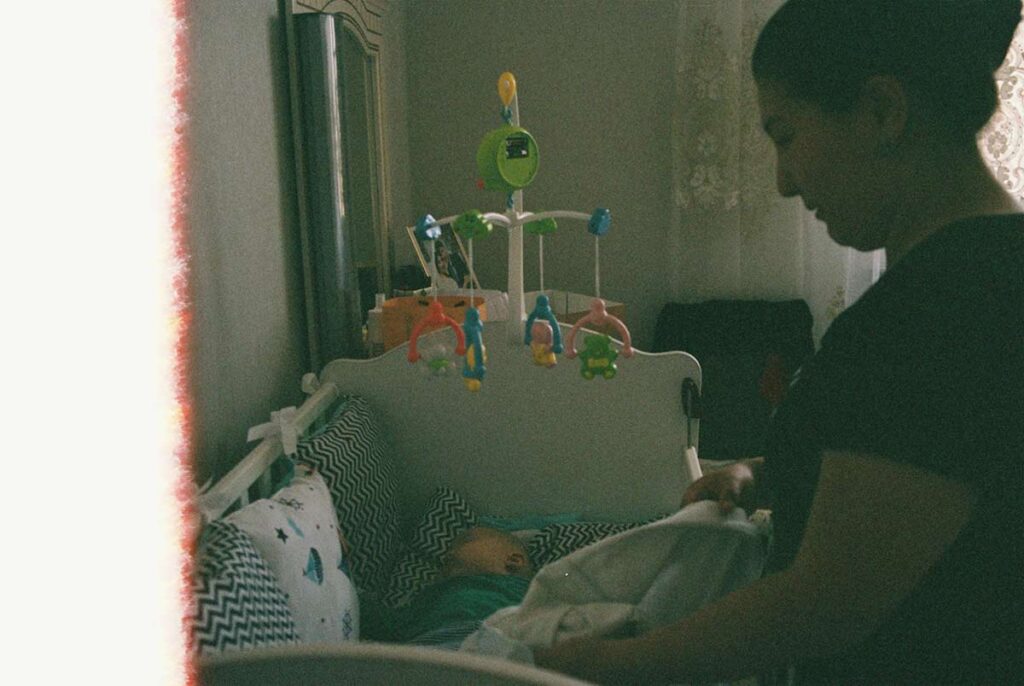
Your baby has finally fallen asleep. Their arms feel heavy, their breathing is quiet, and you wait a few extra minutes before attempting the transfer.
Then their back touches the bassinet.
Eyes open.
If your baby sleeps beautifully on you but wakes the moment you put them down, you may wonder whether the crib is uncomfortable – or whether holding them has created a habit. For young babies, the explanation is often much simpler: your warm, moving body and a flat, still mattress feel completely different.
Photo by DIANA HAUAN on Unsplash
Why Does My Baby Wake Up When I Put Them Down?
A baby sleeping against you has warmth, pressure, movement, your smell, and the rhythm of your breathing.
That preference for closeness also helps explain why skin-to-skin contact with your newborn can feel so settling in the early days.
During the transfer, several of those signals disappear at once.
If your baby also seems happiest in your arms throughout the day, here is why a newborn may want to be held all the time.
Timing matters too. Newborns move through active, light, and deeper sleep, and they are easier to wake during lighter stages. The American Academy of Pediatrics describes newborn sleep as containing substantial periods of active and light sleep before deeper quiet sleep.
Sometimes the problem is not the bassinet. It is the transition.
The Startle Reflex Can Wake a Sleeping Baby
You lower your baby slowly—and suddenly both arms shoot outward.
That may be the Moro reflex, a normal newborn startle response. Cleveland Clinic notes that parents may notice it specifically when laying a baby on their back because the change in position can create a brief sensation of falling.
The reflex gradually fades as the nervous system matures, so transfers may become easier with time.
What Pediatric Professionals See in Real Life
This problem is familiar in pediatric care.
Pediatric nurse practitioner Leslie Brewer, CRNP, describes the classic pattern: a newborn sleeps while being held but wakes after the move to a cooler, flat surface. Her practical approach is to look for deeper-sleep cues—such as relaxed limbs—then lower the baby gradually and briefly keep a reassuring hand on the chest after the transfer.
She also makes an important distinction: expecting every very young newborn to master “drowsy but awake” can create unnecessary pressure on exhausted parents.
How Can You Make the Transfer Easier?
There is no technique that works every time, but a few small changes may help:
- make sure hunger, burping, and diaper needs are handled first;
- give your baby time to become more settled before moving;
- move slowly rather than changing position abruptly;
- lower the body gently while continuing to support the head;
- keep your hand lightly on the chest for a few moments before withdrawing it.
Try when you have some patience left.
At 3 a.m., after four failed transfers, repeatedly starting over may leave both of you more awake and frustrated.
Contact Sleep Is Not the Same as Safe Sleep
Your baby may prefer your chest. That does not make your chest the safest place when you are sleepy too.
The American Academy of Pediatrics recommends placing babies on their backs on a firm, flat sleep surface such as a crib or bassinet, with no pillows, loose blankets, toys, or other soft objects. If you feel yourself becoming drowsy while holding your baby – especially on a sofa or armchair – move them to their safe sleep space.
This is the belief shift worth remembering: the goal is not to stop your baby wanting you; it is to make sure both of you can sleep safely.
When Waking and Fussiness Need a Pediatrician
Waking during transfers alone is usually not a sign of illness. Look at what happens when your baby is awake too.
Seek prompt medical advice if your newborn becomes unusually difficult to wake, feeds poorly, seems weak or floppy, has breathing difficulty, develops an unusual cry, or suddenly behaves very differently from normal. For babies under 12 weeks, fever also warrants prompt medical evaluation.
A baby who is hard to put down is common. A baby who is hard to wake is different.
Frequently Asked Questions
How long should I wait before putting my sleeping baby down?
There is no perfect number of minutes. Instead, watch for a more relaxed body, calmer movements, and deeper-looking sleep before attempting the transfer.
Is it okay if my baby naps on me?
Contact naps can be part of early parenthood, but the caregiver needs to remain fully awake and attentive. If you are becoming sleepy, move your baby to an appropriate safe sleep surface.
Will my baby eventually stop waking during transfers?
Often, transfers become easier as sleep patterns and the nervous system mature. Some babies adjust quickly, while others need more time and gradual practice.
For times when your baby settles more easily against your body, a supportive baby carrier for everyday newborn use can offer closeness while keeping your hands free.
Final Thoughts
A baby who wakes as soon as you put them down is not necessarily rejecting the crib—and you have not necessarily taught them a bad habit.
A baby can be deeply comfortable with sleep and still dislike the transition away from your body.
Keep transfers gentle, keep expectations realistic, and make safe sleep the non-negotiable part.
Does your baby sleep peacefully in your arms but wake the moment you put them down?
Tell us what happens during your transfers and whether you have found anything that makes them easier.
Your experience may help another tired new mom through the same stage.