

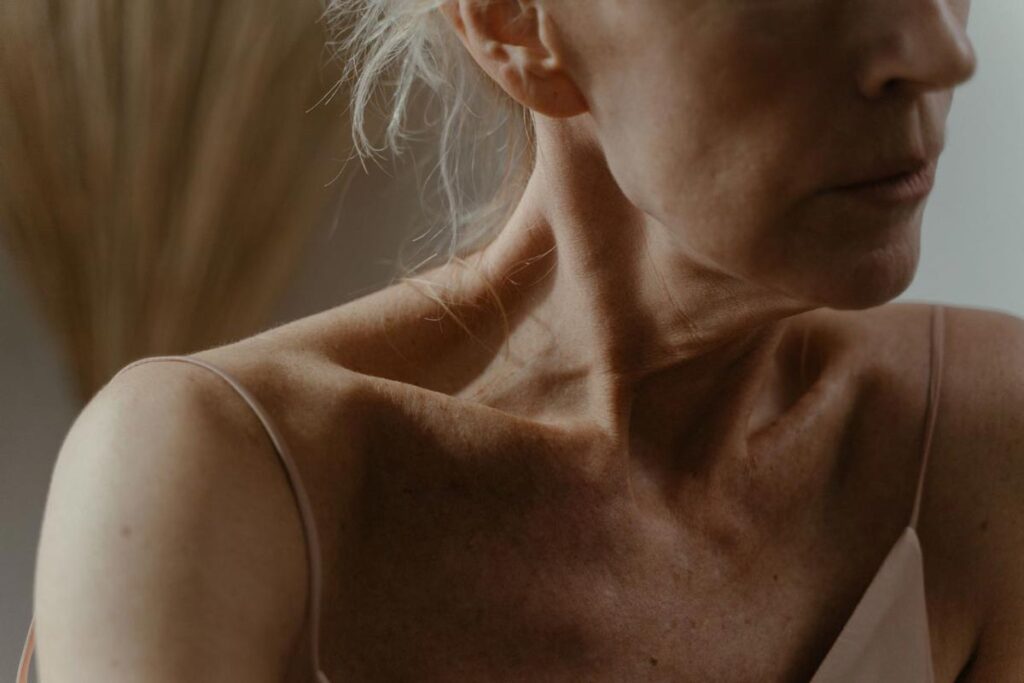
You catch your reflection in bright bathroom light and notice something new: the skin under your eyes looks finely crinkled, while your neck seems thinner and less smooth than it did a few years ago.
It may be more noticeable after a dry winter, weight loss, or simply as you move through your 40s and 50s.
This paper-like texture is often called crepey skin. It is common, usually harmless, and influenced by much more than age alone.
Photo by Ron Lach on Pexels
What Crepey Skin Actually Means
Crepey skin tends to look thin, finely wrinkled, and less elastic, a little like crepe paper. It can appear around the eyes, on the cheeks, neck, chest, or elsewhere on the body.
It is not quite the same thing as a deep wrinkle or loose skin. Crepiness describes texture; laxity describes sagging. The two can exist together, but they do not always respond to the same approach.
Why Your Face and Neck May Start Looking Crepey
Age gradually changes collagen, elastin, natural oils, and hydration. But one of the biggest outside influences is cumulative UV exposure.
Cleveland Clinic dermatologist Amy Kassouf, MD, explains that repeated sun exposure damages elastin and that crepey skin often begins becoming noticeable in the 40s. Dryness, weight changes and long-term use of some medications, including prednisone, can also contribute.
The neck is easy to overlook. You may moisturize your face every morning but stop at the jawline, while years of incidental sun reach your neck and upper chest.
The neck often shows the years we forgot to sunscreen.
A Real Question Dermatologists Hear
One woman in her 40s wrote to dermatologist Robin Evans, MD:
“I’m only in my 40s and my skin is already starting to look like Grandma’s.”
Dr. Evans explained that midlife hormonal shifts can contribute to loss of collagen, elastin and supporting tissue, while lower estrogen may also affect hydration and skin thickness. That does not mean menopause is the only explanation, but it can be one piece of the picture.
If dryness appeared around the same time, learn why menopause can make your skin so dry.
What Can Actually Help?
Protect What You Still Have
Daily broad-spectrum sunscreen on the face, neck and chest matters more than chasing a miracle cream after damage has accumulated.
Some everyday habits can quietly add to visible aging, so it is worth reviewing the habits that can make your skin age faster.
A moisturizer can also make fine crinkling look softer by increasing water in the outer skin layers. Look for ingredients such as glycerin, ceramides or hyaluronic acid, especially if your skin also feels dry or tight.
Consider Retinoids – Slowly
Retinoids can improve signs of photoaging by encouraging remodeling in the epidermis and dermis. A 2024 scientific review found evidence that retinol and related retinoids can improve visible signs of photoaged skin, although tolerance varies.
The neck can be more easily irritated than the face, so starting several nights a week with moisturizer rather than nightly application is often more comfortable.
If your skin now reacts more easily to active ingredients, read why skin can become more sensitive in your 40s.
More active ingredients are not always more effective if irritation is the price.
Know What Creams Cannot Do
This is the belief-shifting part: crepey skin is not simply “very dry skin.”
Hydration may soften its appearance, but a cream cannot completely replace lost structural support or tighten substantial laxity. Providence dermatologist Ramya Rao, MD, notes that crepey skin can often be minimized, but not completely reversed.
For more pronounced changes, dermatologists may discuss treatments such as lasers, radiofrequency, ultrasound or other procedures depending on the area and skin type.
When a Skin Change Deserves a Closer Look
Gradual texture changes without other symptoms are usually part of aging and photoaging.
But a dermatologist should evaluate skin that changes suddenly, or crepey-looking areas accompanied by persistent redness, scaling, pain, severe itching, unusual bruising or bleeding. Those features may point to something other than ordinary skin aging.
Frequently Asked Questions
Can crepey skin start in your 40s?
Yes. Some women first notice it in their 40s, especially when sun exposure, dryness, hormonal changes or weight fluctuations overlap.
Can moisturizer get rid of crepey skin?
Moisturizer can make dry, fine surface lines look softer and more comfortable, but it cannot fully rebuild lost collagen or tighten significant loose skin.
Can weight loss make the neck look more crepey?
It can. Losing volume may make pre-existing skin laxity or fine texture more visible, particularly after substantial or rapid weight loss.
If you’re considering retinol for fine texture and visible signs of aging, our roundup of retinol serums for mature skin can help you compare gentler options before adding one to your routine.
Final Thoughts
Crepey skin is not a sign that you suddenly “aged overnight.” It usually reflects years of sun exposure, natural structural changes, dryness and sometimes hormonal or weight-related shifts becoming visible at the same time.
Protecting your skin now still matters. Sunscreen, consistent moisture and carefully introduced retinoids may improve texture and help limit further photoaging, even if they cannot erase every change.
Have you noticed crepey skin becoming more visible on your face or neck?
Was there a skincare change that made the biggest difference for you?
Share your experience in the comments — another reader may be noticing the same change.