

You have 20 minutes before dinner and want to squeeze in a strength workout.
The dumbbells are beside the mat. The resistance bands are tucked into a drawer. Both can make your muscles work – but which one is actually better for training at home?
The answer depends less on whether you are a “dumbbell person” or a “band person” and more on how you want to train, how much space you have, and how easily you can progress the resistance.
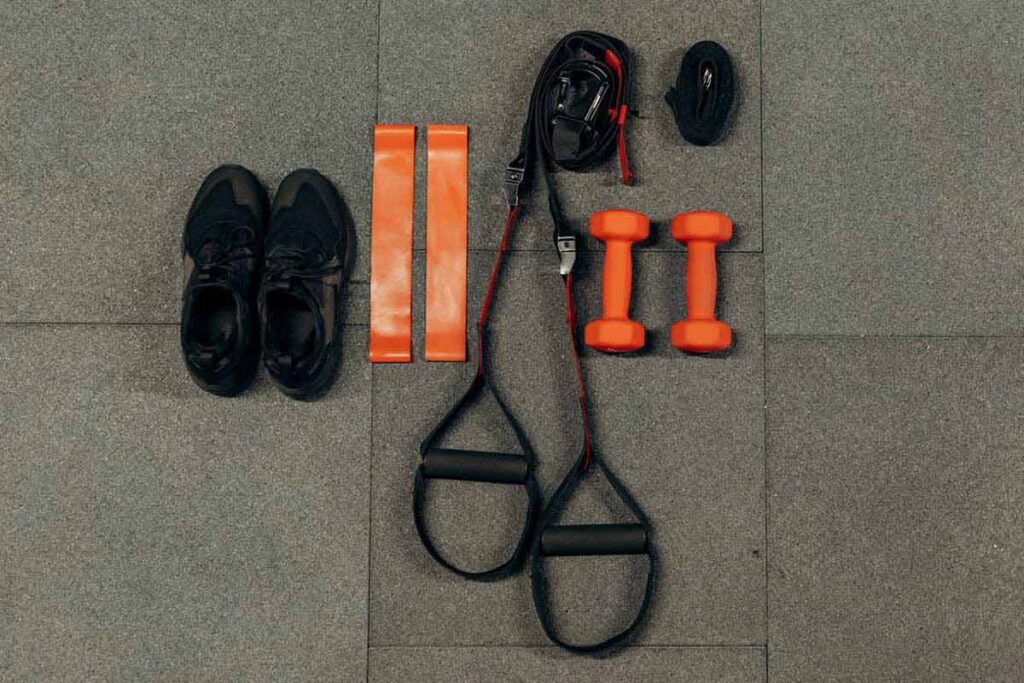
Photo by Mikhail Nilov on Pexels
Dumbbells vs Resistance Bands: The Short Answer
Dumbbells are usually easier for tracking progress because the weight is fixed and clearly marked. If you move from 10 pounds to 12 pounds, you know exactly what changed.
Resistance bands are lighter, cheaper to store and easier to travel with. Their resistance increases as the band stretches, so the challenge changes through the movement.
Dumbbells make progress easier to measure. Bands make strength training easier to fit into your life.
Sports medicine physician Evan Peck, MD, told Cleveland Clinic that progressive resistance training can include dumbbells, barbells, machines, resistance bands or weighted vests. His advice for beginners is practical: use manageable resistance, build solid technique first, then gradually add load.
Where Dumbbells Have the Edge
Dumbbells feel straightforward.
You pick them up, perform the exercise and know exactly how much weight you are using. That makes them especially useful for squats, Romanian deadlifts, rows, presses and other exercises where you want to follow gradual increases over time.
If you are unsure what weight to begin with, our guide to how heavy dumbbells should be for women explains how reps and form can help you decide.
Their downside is practical. A collection of fixed dumbbells takes up space, and buying several weights can become expensive.
Where Resistance Bands Make Home Workouts Easier
Bands win when space is limited.
A few loop bands can fit inside a drawer, suitcase or gym bag, yet they can be used for rows, presses, glute work, lateral walks and many other movements.
They are also easy to adjust by changing band tension, hand position or how far the band is stretched.
That flexibility has one drawback: resistance is harder to measure precisely than a number printed on a dumbbell.
If bands suit your setup better, see our guide to the best resistance bands for women for different home-workout options.
Resistance Bands Are Not Just for Warm-Ups
This is where many people underestimate them.
Bands are light in your drawer, not necessarily light on your muscles.
A systematic review and meta-analysis of eight studies found that elastic resistance produced strength gains comparable with conventional resistance training for upper- and lower-body strength. The studies involved different populations and training protocols, so this does not prove that bands and dumbbells are identical for every woman or every exercise.
What matters is whether the resistance is challenging enough and can progress as you get stronger.
Which One Is Better for Your Goal?
Choose dumbbells if you want:
- clearly measurable resistance
- simple progression from one weight to the next
- traditional strength exercises
- heavier loading as you become stronger
Choose resistance bands if you want:
- minimal storage space
- equipment you can travel with
- several resistance levels without a rack of weights
- more exercise options in a small room
If your current weight is becoming easy, our guide on when to increase weight in strength training can help you decide whether it is time to progress.
Do You Really Have to Choose?
No.
For many home workouts, the most useful setup is actually a small pair of dumbbells plus several resistance bands.
You might use dumbbells for squats and rows, then switch to a loop band for lateral walks or glute work. On a busy week or while traveling, the bands can handle the whole workout.
The best home-workout tool is the one you can progress with — and actually use consistently.
If you are just getting started, beginner strength training for women can help you build a simple routine before worrying about having the perfect equipment.
Frequently Asked Questions
Can resistance bands replace dumbbells?
For many exercises, yes. Bands can provide meaningful resistance and can be progressed, but dumbbells may be easier when you want precise, heavier loading.
Are resistance bands better for beginners?
Not automatically. Some beginners like their portability and adjustable tension, while others find a fixed dumbbell easier to understand and control.
Which is better for “toning” — bands or dumbbells?
“Toning” usually means building some muscle while reducing enough body fat for muscle shape to become more visible. Both bands and dumbbells can contribute to the strength-training part of that goal when the resistance is challenging enough.
If measurable increases in resistance are what draw you toward dumbbells, our comparison of adjustable dumbbells for women can help you find an option that fits your space and goals.
Final Thoughts
There is no universal winner in the dumbbells vs resistance bands debate.
If you value simple, measurable progression, dumbbells have an advantage. If storage, travel and flexibility matter more, resistance bands may fit your life better.
And for many women, the smartest answer is simply both.
Do you reach for dumbbells or resistance bands more often when you work out at home?
Or do you use both depending on the exercise?
Tell us which one has earned a permanent place in your home workout.