

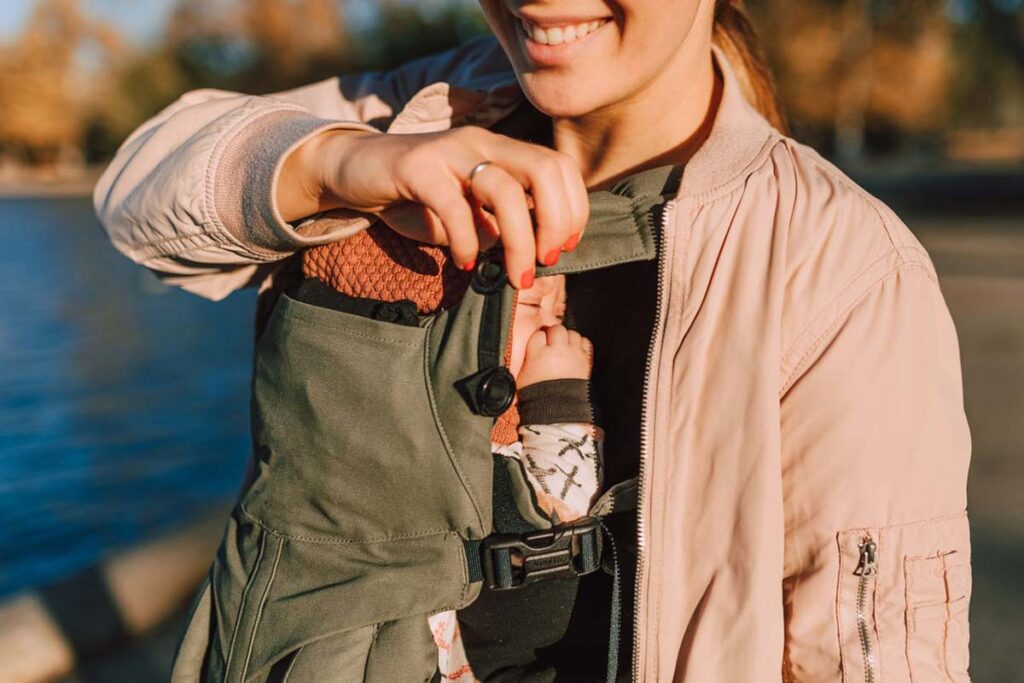
Your newborn finally settles against your chest, but you still need to make lunch, answer the door, or simply use both hands for five minutes.
A carrier sounds perfect.
Then come the questions: Is your baby too young? Is their head high enough? Are those tiny legs supposed to look like that?
Babywearing can be practical and comforting from the newborn stage, but fit matters more than the style or price of the carrier. A few positioning checks can make the difference between a secure carry and one that needs to be adjusted.
If your newborn is still in those very early days, skin-to-skin contact is another simple way to offer warmth and closeness while you are both awake.
Photo by RDNE Stock project on Pexels
When Can You Start Babywearing a Newborn?
Many carriers are designed for use during the newborn stage, but there is no universal “day one” rule for every product or every baby.
If your baby seems happiest in your arms from morning to night, here is why a newborn may want to be held all the time.
Check the manufacturer’s minimum weight, age, newborn setting, and any required insert before the first use. In Babylist’s expert Q&A, parents are specifically reminded that newborns have limited head and neck control and cannot easily reposition themselves if their airway becomes compromised; carrier weight limits also vary considerably.
The safest starting point is not a date on the calendar. It is a carrier that correctly fits your baby today.
What Should a Newborn Look Like in a Carrier?
For a young newborn, think high, close, upright, and facing inward.
You should be able to glance down and see your baby’s face. Their nose and mouth should remain uncovered, the chin should stay away from the chest, and the carrier should support the back rather than allowing the baby to slump.
The NCT summarizes this with the T.I.C.K.S. approach: Tight, In view, Close enough to kiss, Keep chin off the chest, Supported back. It also advises extra caution for babies under four months and recommends professional guidance before using a carrier with a premature, low-birth-weight, or medically vulnerable baby.
Hands-free does not mean attention-free. Keep checking your baby while you move.
What About the Baby’s Hips?
A newborn’s legs should not simply hang straight down.
In a useful expert discussion on PedsDocTalk, pediatrician Dr. Mona Amin asks babywearing educator Laura Brown about hip positioning. Brown explains that newborns naturally assume a spread-squat position, with the knees at or above the level of the bottom, and that adjustable carriers can help maintain that position as the baby grows.
Picture an “M” shape: bottom lower, knees higher, thighs supported.
But do not force the legs wider than they naturally want to go. A good carrier adapts to a newborn; the newborn should not have to adapt to the carrier.
How Long Can a Newborn Stay in a Carrier?
There is no useful single number that fits every newborn.
Instead of watching a stopwatch, regularly reassess:
- Is the face still visible?
- Is the chin still away from the chest?
- Does the baby feel too warm?
- Is the carrier still snug rather than sagging?
- Does your baby need feeding, a diaper change, or movement outside the carrier?
- Are your own shoulders, back, or incision becoming uncomfortable?
A ten-minute carry can be enough on one day. Another day, a longer walk may work comfortably.
The baby’s position matters more than reaching a particular number of minutes.
Everyday Situations That Need Extra Care
You put the baby in the carrier, they fall asleep within minutes, and suddenly you are tempted to treat the carrier like a portable crib.
If carrier naps are easy but bassinet transfers are not, our guide explains why your baby wakes when put down and what may make the transition gentler.
That is where attention matters.
Stay awake and keep monitoring the airway. Avoid cooking over heat, handling hot drinks, running, cycling, or doing activities where a fall could injure the baby.
And if the fit starts to look wrong, stop and reset it. A carrier that felt perfect at 9 a.m. can loosen after walking, feeding, or repeated movement.
When Should You Ask for Help?
Get individualized advice before babywearing if your baby was premature, has a low birth weight, breathing problems, low muscle tone, significant reflux, or is being treated for a hip condition.
Also stop babywearing immediately if your baby becomes unusually limp, difficult to rouse, changes color, or appears to struggle to breathe. Those are not fit problems to troubleshoot while continuing the walk.
For positioning questions without medical symptoms, a trained babywearing educator can often help you adjust straps, seat width, and carrier height.
Frequently Asked Questions
Can a newborn face outward in a baby carrier?
Not during the early newborn stage. Young babies generally need inward-facing support while head and neck control are still developing; follow the specific carrier’s instructions before changing positions.
Can my newborn sleep while I am babywearing?
Babies often doze in carriers. The adult should remain awake and continue checking that the baby’s face is visible and airway position stays safe.
Should I buy a wrap or a structured carrier for a newborn?
Either can work if it is designed for your baby’s size and you can achieve a secure fit. The best choice is the one you can correctly put on, tighten, and check every time.
Once you understand the basics of safe positioning and fit, compare our baby carrier picks for newborns to see which style may suit your routine best.
Final Thoughts
Babywearing does not need to feel intimidating, but newborn positioning deserves your full attention.
High, visible, supported, and close is a better safety checklist than simply asking whether a carrier is “newborn approved.”
Choose a carrier that fits both of you, practice before heading out, and reset the fit whenever something looks or feels wrong.
Babywearing can give you two free hands without giving up the closeness your newborn still needs.
Start with the right fit, keep the airway visible, and let comfort and your baby’s cues guide how long each carry lasts.
Explore more practical newborn and early motherhood guides on BloomHerLife.