

You close your laptop after a long day and only then notice how stiff your neck feels.
Your shoulders have crept upward, your hips feel tight when you stand, and your lower back seems to need a few seconds before it agrees to move.
Sitting for hours can leave certain muscles feeling stiff or sore, especially around the neck, shoulders, back, and hips.
You do not need a full workout every time that happens.
A few gentle stretches – combined with regular breaks from sitting – can help your body move more comfortably through the day.
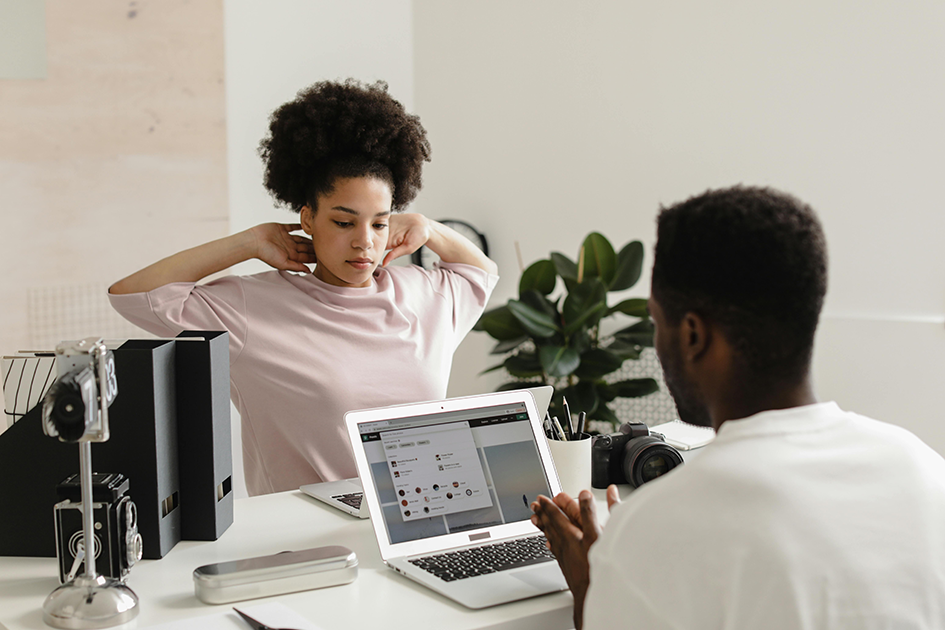
Photo by Ron Lach on Pexels
Why Sitting All Day Can Leave You Feeling Stiff
The problem is not that sitting is automatically harmful every time you do it.
It is staying in the same position for long periods with very little movement.
Mayo Clinic notes that prolonged desk work can place stress on muscles in the neck, shoulders, and upper back, contributing to stiffness and soreness.
Short fitness breaks can be one practical way to interrupt that pattern.
1. Gentle Neck Stretch
If screen time leaves one side of your neck feeling tight, start gently.
Sit or stand tall.
Let your shoulders relax.
Slowly tilt your head toward one shoulder until you feel a mild stretch along the opposite side of your neck.
Hold briefly, then repeat on the other side.
Do not pull your head downward with your hand.
The goal is gentle tension, not forcing a greater range of motion.
2. Shoulder Rolls
Desk work can leave your shoulders feeling as if they have been sitting near your ears all afternoon.
Sit or stand upright and slowly roll your shoulders backward several times.
Then reverse the direction.
Keep the movement controlled rather than making large, forceful circles.
Pairing the movement with slow breathing can also help you notice when you are unnecessarily holding tension.
3. Chest Stretch
Hours spent leaning toward a laptop or phone can make the front of your upper body feel tight.
Stand tall and bring your hands gently behind you, or place your hands against the sides of a doorway.
Open your chest only until you feel a comfortable stretch.
Keep your shoulders relaxed and avoid forcing them backward.
4. Seated Spinal Rotation
Use a stable chair without wheels.
Sit upright with both feet supported.
Slowly rotate your upper body toward one side while keeping the movement comfortable.
Return to the center and repeat on the other side.
This should feel like an easy mobility movement rather than an attempt to twist as far as possible.
5. Hip Flexor Stretch
Your hip flexors spend much of the workday in a shortened position while you are seated.
To stretch them, use a split stance or gentle kneeling lunge.
Keep your torso upright and slowly shift your hips forward until you feel a stretch through the front of the hip on the back-leg side.
Do not arch your lower back to create a bigger stretch.
If getting onto the floor is uncomfortable, use a chair or desk for support.
6. Seated Hamstring Stretch
Move toward the edge of a stable chair.
Extend one leg in front of you with your heel resting on the floor.
Keeping your back relatively straight, hinge forward slightly from the hips until you feel a gentle stretch behind the thigh.
Mayo Clinic uses a similar workplace stretch and recommends holding it for about 30 seconds before changing sides.
7. Cat-Cow
If you have room to get onto your hands and knees, cat-cow can be a gentle way to move your spine after sitting.
Begin with your hands beneath your shoulders and knees beneath your hips.
Slowly round your back upward.
Then reverse the movement gently, allowing your chest to open without forcing your lower back.
Move at a comfortable pace with your breathing.
For women who want to add more strength alongside mobility work, these core-strengthening exercises may be a useful next step.
8. Standing Side Stretch
Stand comfortably with your feet stable.
Raise one arm overhead and gently lean toward the opposite side.
You should feel a light stretch along the side of your torso.
Return to the center and repeat on the other side.
Avoid twisting or collapsing forward while you stretch.
Stretching Is Helpful — But Do Not Forget to Move
A five-minute stretching session does not cancel out an entire day without movement.
The CDC’s guidance for adults is simple: move more and sit less.
Some activity is better than none, while adults should work toward at least 150 minutes of moderate-intensity activity each week plus muscle-strengthening activity on two or more days.
That does not mean every movement break needs to become exercise.
Stand while you take a phone call.
Walk to refill your water.
Take a short lap after lunch.
Stretch between two work tasks.
If you want an easy way to add more movement without equipment, try our 10-minute daily workout for women.
For everyday movement rather than structured workouts, see our simple daily movement routine for women.
How Hard Should a Stretch Feel?
A useful stretch does not need to hurt.
Mayo Clinic advises gentle stretching without bouncing and gives one particularly useful rule:
“If you feel pain, you’ve stretched too far.”
For many static stretches, holding for about 30 seconds is a common guideline.
Ease out of any stretch that causes sharp pain, numbness, tingling, dizziness, or worsening joint or back pain.
If you have an injury, recent surgery, osteoporosis, significant joint problems, or another condition affecting movement, ask a healthcare professional or physical therapist which stretches are appropriate for you.
Frequently Asked Questions
How often should I stretch if I sit all day?
You do not need a long stretching session every hour.
Short movement breaks during the day, combined with gentle stretches when an area feels stiff, may be easier to maintain than doing everything at the end of the day.
How long should I hold each stretch?
For many static stretches, about 30 seconds is a reasonable guideline.
Stay relaxed, breathe normally, and do not bounce or force the position.
Is stretching enough if I sit all day?
No.
Stretching can support flexibility and comfortable movement, but walking, general physical activity, and strength training also matter.
Try to break up long periods of sitting rather than relying on stretching alone.
Should stretching hurt?
No.
Mild pulling or tension is expected, but pain is a signal to reduce the stretch or stop.
Final Thoughts
Sitting for hours can leave your neck, shoulders, back, and hips feeling stiff, but you do not need a full workout every time your body asks for movement.
A short walk, a few gentle stretches, or simply standing between tasks can break up long periods of sitting.
The goal is not perfect flexibility. It is giving your body more chances to move during the day.
Sometimes one area starts asking for movement long before the rest of your body feels stiff.
Share your go-to desk stretch or movement break in the comments — another woman may find an idea she can use during her own workday.