You agree to one more commitment even though you’re already tired. After a conversation, you replay everything you could have said differently. Or a small mistake stays with you for the rest of the day, along with a familiar question: Why did I do that again?
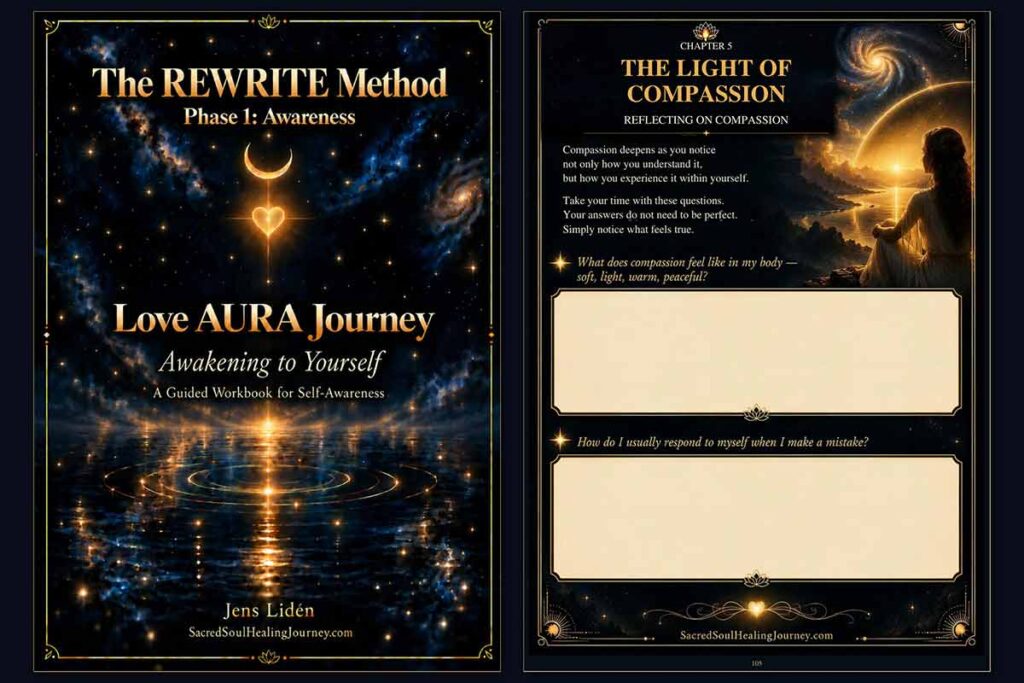
Sometimes you want to write about it, but a blank page leaves you wondering where to begin. In this REWRITE Method review, we look at Jens Lidén’s Phase 1: Awareness workbook, which offers prompts, short exercises, and space for your answers.
If you want to pay closer attention to your feelings, recognize familiar reactions, and practice speaking to yourself more kindly, this workbook gives you a place to begin.
Image courtesy of Jens Lidén. Used with permission.
In This Article
Affiliate disclosure
The author provided BloomHerLife with a free copy for an independent assessment. We reviewed the complete PDF. If you buy through an affiliate link in this article, BloomHerLife may earn a commission at no extra cost to you.
What’s Inside the Workbook
The REWRITE Method — Phase 1: Awareness is a digital workbook with 198 pages, supplied as a fillable PDF.
Across eight chapters, it covers noticing your thoughts and reactions, bringing your attention to the present, your relationship with yourself, emotional reflection, self-compassion, daily practices, and affirmations. The closing section invites you to choose what you want to continue practicing.
The pages combine:
- short introductions and explanations;
- guided awareness and self-reflection exercises;
- questions for personal reflection;
- affirmations and room for your own responses.
A substantial part of the workbook is reserved for your writing. The format is especially useful if you like to pause with a question and connect it to something you’ve actually experienced.
Explore The REWRITE Method on Gumroad
Exercises You Can Use in Everyday Life
Pausing Before You Respond
One of the workbook’s most practical sections looks at automatic reactions.
Imagine a coworker sends you another task near the end of the workday. You say yes right away, then only later notice how tense and frustrated you feel. The exercises ask you to return to that moment and write down what happened, what you thought, how you felt, and what you did.
Next, you consider how a brief pause might have changed your response. Perhaps you would have checked your schedule or asked for a little time to get back to them.
A useful first step is noticing when you tend to set your own needs aside.
Recognizing What You Feel
The chapter on emotional reflection encourages you to name what you’re feeling and notice any physical sensations that accompany it. There’s also room to admit that you’re not sure what you feel yet.
In an account of his psychotherapy practice, clinical psychologist Chris Germer describes Paul, a client who spoke angrily about his former partner after a breakup. When Germer helped him recognize his anger, the tone shifted and there was room to explore the pain of the breakup.
That example comes from psychotherapy and illustrates the value of naming an emotion. The workbook offers simple prompts and space to write as a way of pausing to notice your own feelings.
Being Kinder to Yourself About Mistakes
The pages on self-criticism are particularly worthwhile. They ask you to notice what you tell yourself when something goes wrong and consider how you would respond to someone you care about.
A forgotten phone call or an unfinished task can quickly turn into a much broader judgment about who you are. Writing gives you somewhere to examine that judgment and try expressing it in a way that’s fairer to yourself.
You can acknowledge a mistake and give yourself room to correct it. That balance of responsibility and understanding is what we like about this part of the workbook.
When a Little Guidance Helps You Write
A blank notebook gives you freedom, but it can sometimes be easier to start with a question in front of you.
Here, you can focus on a specific topic: a reaction that keeps coming up, a feeling you struggle to name, or the way you talk to yourself. The prompts provide a framework; the answers are your own.
We appreciate the author’s frequent reminders that your answers don’t have to be perfect. You can slow down, skip a prompt, and return to it later.
The workbook also includes short morning and evening practices. They can serve as a reminder to check in with how you feel, alongside planning what needs to get done.
About his free 25-page workbook, A First Step Toward Yourself, Jens Lidén told BloomHerLife:
Unlike a typical preview containing extracts from the paid workbook, this is a separate introductory experience with its own original guidance and reflection exercises.
Who Might Enjoy This Approach
We’d recommend this workbook to readers who enjoy guided journaling and a warm, spiritual approach to personal growth.
Lidén writes about the soul, light, inner wisdom, and energy. He includes visualizations of golden light, affirmations, and a closing ceremony. Deep blue and black backgrounds, gold details, and ornate illustrations carry that style throughout the PDF.
If that atmosphere appeals to you, the design may give you another reason to open the workbook and make time for it. You’ll return to certain questions and ideas from different angles, so it makes sense to set your own pace.
If you recognize the urge to overexplain, for instance, you could choose one such situation as your journaling topic. The workbook primarily guides you through exploring your own reactions and your relationship with yourself.
How to Get Started
Begin with one short exercise and one ordinary situation from the past day. You could set aside about ten minutes, without committing to finish an entire chapter.
You can type your answers into the PDF or keep them in a separate notebook. If you prefer pen and paper, the author allows printing for personal use.
Some days, your answer may only be two sentences long. On others, you may want more space. Let that guide how much you write.
Try This Today
Think of a moment from today that you keep replaying. Write down how you felt and what you needed at the time, without pressuring yourself to find a solution right away.
Frequently Asked Questions
Will I receive a printed book?
You’ll receive a downloadable PDF. You can use it on your device or print a copy for personal use.
How do I save my answers in the PDF?
Download the file and open it in a PDF reader that supports fillable forms. Save your own copy, close it, and reopen it to check that your answers have been saved.
Do I need the later phases?
You can work through the Phase 1 exercises using this workbook alone. The closing pages introduce the themes of later phases, and the author encourages readers to continue at their own pace.
Is this a form of psychotherapy?
This workbook is intended for independent self-reflection and personal growth. Psychotherapy involves professional assessment and working with a therapist. If writing brings up a subject you find difficult to manage, you can pause and seek support.
Final Thoughts
We’d recommend The REWRITE Method — Phase 1: Awareness to readers who want to make guided journaling part of their daily lives and who enjoy its spiritual style.
Its strongest feature is the way it invites you to take part: pause with a prompt, connect it to your own experience, and write an answer. The exercises on automatic reactions and how we talk to ourselves after a mistake stood out to us.
If you’ve wanted to start journaling for a while but need a little structure, this workbook offers a clear starting point and enough room to make it your own.
If you’d like to explore the later phases of The REWRITE Method, Jens Lidén offers three more PDF workbooks.
BloomHerLife may earn a commission if you buy through the links below, at no extra cost to you.
Do you find it easier to understand your feelings when you write them down?
What question would you want to find on the first page of a journal?
Share your experience in the comments.