

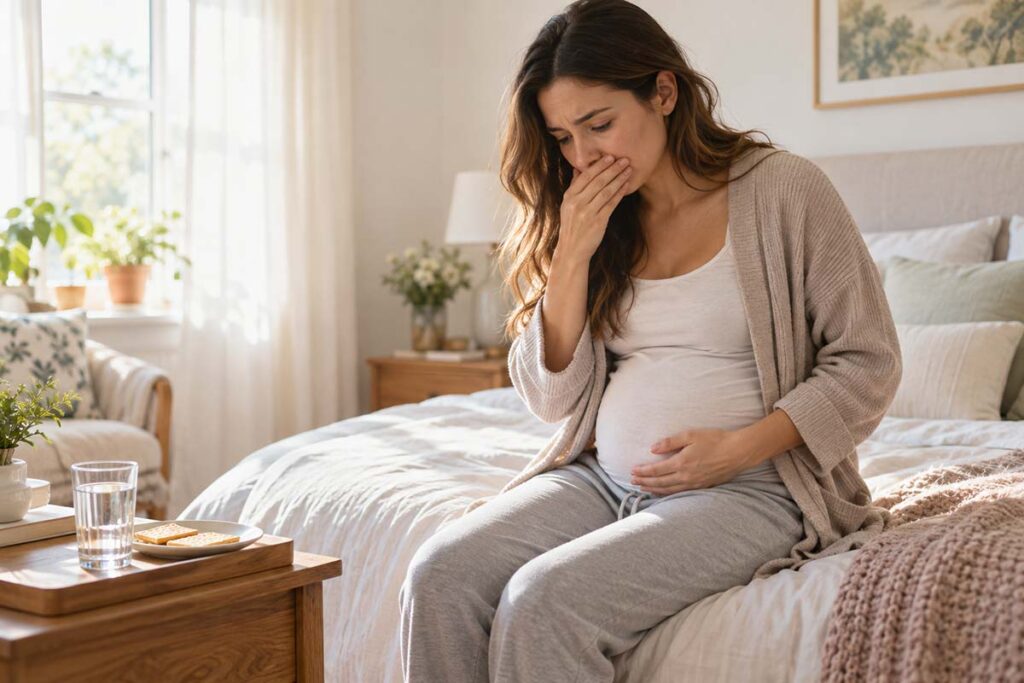
“Morning sickness” is a misleading name. Pregnancy nausea can appear in the morning, afternoon, evening, or last much of the day.
It usually begins early in pregnancy. The Royal College of Obstetricians and Gynaecologists reports that nausea and vomiting settle by 20 weeks in about 9 out of 10 pregnant women, while the severe form, hyperemesis gravidarum, can affect up to 3 in 100.
Mild nausea can often be managed at home, but you do not have to simply endure symptoms that are making it difficult to eat, drink, work, or function normally.
AI-generated with ChatGPT
1. Eat Smaller Amounts More Often
A completely empty stomach can make nausea harder for some women.
Certified nurse-midwife Jessica Costa, MSN, APRN, CNM, explains:
“It may seem counterintuitive, but an empty stomach can actually make nausea worse.”
Small meals or snacks every few hours may be easier than three large meals. Crackers, toast, rice, potatoes, yogurt, fruit, nuts, or whatever foods you currently tolerate can all be reasonable options.
Do not worry if your meals look unusually simple for a while. During a nauseous morning, eating something you can tolerate may be more realistic than trying to create a perfect pregnancy breakfast.
For broader nutrition guidance, see our simple guide to balanced eating during pregnancy.
2. Sip Fluids Instead of Drinking a Large Amount at Once
Vomiting can lead to dehydration, but a large glass of water may feel difficult when your stomach is already unsettled.
Try smaller, frequent sips throughout the day. Cold water, ice chips, or another pregnancy-safe drink may sometimes be easier to tolerate.
Your urine can provide a useful clue. Very dark urine or urinating much less than usual can be signs that you are not getting enough fluid.
3. Notice Your Smell and Food Triggers
Pregnancy can change both smell and taste sensitivity.
Cooking odors, perfume, smoke, fried food, or foods that normally do not bother you may suddenly trigger nausea.
Cold or room-temperature meals sometimes produce less smell than hot food. Opening a window, letting someone else cook when possible, or temporarily avoiding a particular trigger is reasonable.
You do not need to force yourself to eat a food simply because it is considered “healthy.”
4. Ginger May Help Some Women
Ginger is one of the more commonly suggested non-drug approaches for pregnancy nausea.
The NHS notes that some pregnant women find ginger products helpful, including ginger tea, ginger biscuits, or crystallized ginger. It also emphasizes staying hydrated and eating smaller meals.
More is not necessarily better. Ginger supplements can contain concentrated doses, so discuss supplements with your pregnancy care provider rather than assuming that “natural” automatically means appropriate during pregnancy.
5. Rest When Fatigue Makes Nausea Harder
Nausea can be exhausting, and exhaustion can make an already difficult day feel worse.
Give yourself permission to simplify your schedule when possible. That might mean a slower morning, an earlier bedtime, or leaving a nonessential task for another day.
Gentle movement may still feel good when symptoms allow it. Our guide to safe exercise during pregnancy explains how activity can be adjusted as pregnancy changes.
6. Ask About Vitamin B6 and Doxylamine
You are not limited to crackers and ginger if nausea continues.
ACOG states that vitamin B6 (pyridoxine) may be tried first, and doxylamine can be added if B6 alone does not provide enough relief. A prescription medication combining the two is also available. ACOG considers these options safe during pregnancy when used appropriately.
Talk with your obstetric care provider about the right option and dose for you rather than starting medication based only on an online recommendation.
Other anti-nausea medicines can also be prescribed when necessary.
7. Do Not Wait Too Long to Ask for Help
Severe pregnancy sickness is different from simply feeling queasy.
A Mayo Clinic Q&A described a woman who was 15 weeks pregnant, nauseated throughout the day, and losing weight. Her concern was whether the weight loss could affect her pregnancy. The response emphasized that although morning sickness is usually not dangerous, persistent nausea with weight loss deserves medical attention and treatment rather than simply waiting for it to pass.
That is an important distinction: home strategies are for managing symptoms, not for proving how much discomfort you can tolerate.
When Morning Sickness May Be Hyperemesis Gravidarum
Contact your pregnancy care provider if you cannot keep food or fluids down, are losing weight, feel dizzy or faint, or notice very little or very dark urine.
The NHS also advises seeking medical help when vomiting is severe enough that dehydration or inadequate nutrition becomes a concern. Hyperemesis gravidarum may require medication, fluids, and sometimes hospital treatment.
Nausea or vomiting that begins unusually late, occurs with abdominal pain, fever, painful urination, or other new symptoms may also need evaluation for causes unrelated to typical pregnancy sickness.
Final Thoughts
Morning sickness can be common without being easy.
Try smaller meals, frequent sips of fluid, fewer triggering smells, rest, and ginger if it agrees with you. If those steps are not enough, ask about safe medical treatment rather than assuming you must manage pregnancy nausea “naturally.”
And if you are feeling emotionally worn down by persistent symptoms, our guide to pregnancy stress and anxiety may also help you find additional support.
Morning sickness can look very different from one pregnancy to another.
Share what helped you in the comments below — your experience may help another mom-to-be feel a little more prepared.
I’m currently 9 weeks pregnant and honestly the nausea has been much harder than I expected. 😔
Some mornings I can barely eat anything, and certain smells make me feel sick immediately.
What helped me a little was eating smaller meals and keeping crackers next to the bed before getting up. Lemon water also seems to calm my stomach sometimes.
It’s comforting to know I’m not the only one going through this. ❤️
Thank you for sharing this, Samantha. I’m glad the smaller meals and crackers are helping a little. Pregnancy nausea can be incredibly tiring, especially in those early weeks, and you’re definitely not alone in this. ❤️