

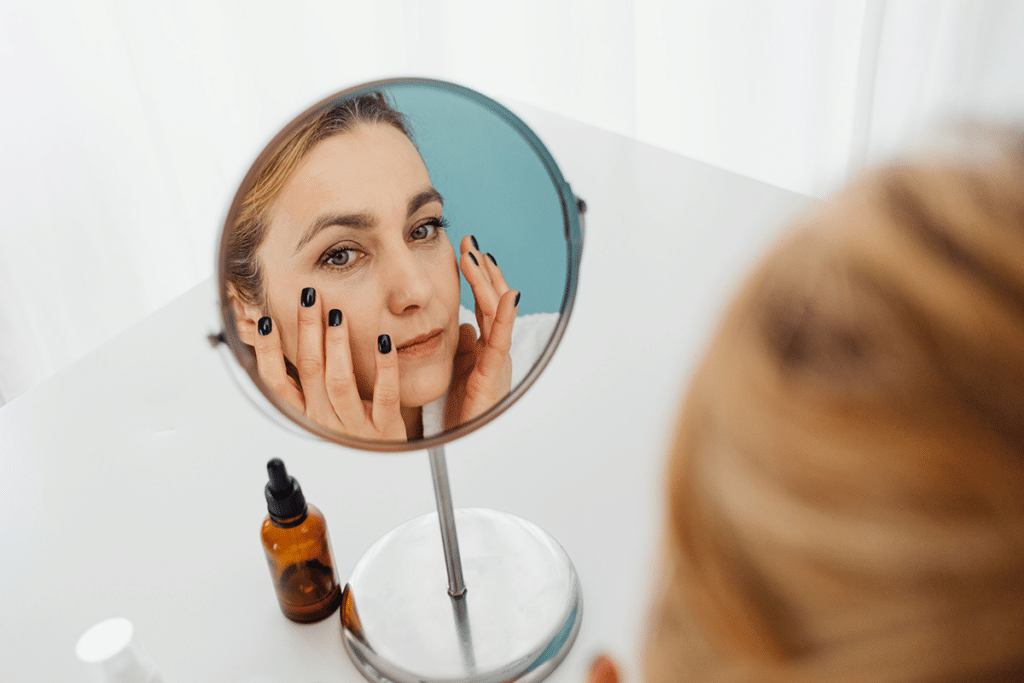
You cleanse, moisturize, use sunscreen, and rarely skip your skincare routine. Yet somehow your complexion still looks tired, flat, or less luminous than you expect.
That does not necessarily mean your routine is “bad.” Dull-looking skin can come from several small things working together — dryness, uneven texture, accumulated dead skin cells, sun exposure, irritation, or simply changes that happen with age.
Image credit: Photo by kaboompics.com on Pexels
What Does “Dull Skin” Actually Mean?
Dull skin is not a medical diagnosis. Usually, people use the term when their complexion seems less reflective, uneven, rough, or tired-looking.
Skin tends to look more luminous when its surface is smooth and well hydrated. When that surface becomes dry or uneven, light scatters differently and the complexion can appear flatter.
Why Your Skin May Still Look Dull
1. Your Skin May Need More Moisture
Skin can look dull before it becomes obviously flaky. Dryness may also make fine lines and texture more noticeable.
Cleveland Clinic explains that dry skin often looks dull and feels tight or rough, particularly when it lacks enough natural oil. If your skin also feels uncomfortable after cleansing, it may be worth checking whether you are dealing with dehydrated skin, rather than immediately adding another active ingredient.
2. Dead Skin Cells Can Change How Light Reflects
Skin naturally sheds cells, but the surface can become rougher over time. Harvard Health notes that the outermost layer may thicken with age, which can contribute to roughness and reduced luminosity.
Gentle alpha-hydroxy acids can help smooth the surface, but more exfoliation is not automatically better. If your skin already stings, burns, or feels tight, give it time to recover before adding another acid.
Our guide to how often you should exfoliate can help you find a gentler starting point for your skin type.
3. Sun Exposure Can Quietly Affect Your Complexion
You do not need a visible sunburn for UV exposure to influence the way your skin looks.
Cleveland Clinic dermatologist Shilpi Khetarpal, MD, explains that UVA exposure can contribute to dullness and pigmentation even while driving or sitting near a window. That makes daily sunscreen one of the least glamorous — but most important — parts of a brightening routine.
4. Your Routine May Be Doing Too Much
Retinoids, exfoliating acids, vitamin C, scrubs, masks, and brightening serums can all have a place in skincare. Using several at once, however, can leave your skin irritated rather than radiant.
If your pursuit of glow is creating redness, tightness, or flaking, simplify first. A calmer skin barrier often looks healthier than skin that is constantly being “treated.”
These simple habits can help you protect your skin barrier naturally while it recovers.
A Real-Life Example: When More Exfoliation Wasn’t the Answer
A reader on RealSelf described taking low-dose Accutane and becoming frustrated by dry, dull-looking skin. She wondered whether adding weekly exfoliation would remove the buildup and improve the texture.
Board-certified dermatologists answering the question cautioned that additional exfoliation could create even more dryness, redness, and irritation. One specifically noted that most patients taking isotretinoin cannot tolerate extra drying treatments and suggested focusing on moisturizer instead.
It is a useful reminder that skin that looks dull is not always asking to be exfoliated.
What Can Help Dull Skin Look Healthier?
Go Back to the Basics
For a week or two, pay attention to the essentials: gentle cleansing, moisturizer, and broad-spectrum sunscreen.
If mornings have become complicated, revisit the best order to apply your morning skincare products.
If your routine contains several actives, reducing them temporarily can make it easier to see what your skin actually tolerates.
Exfoliate Carefully
If your skin is comfortable and not irritated, gentle exfoliation may help uneven texture. Start slowly rather than trying to “polish” dullness away.
Your skin should feel smooth afterward — not tight, hot, or sore.
Give Your Routine Time
Skincare rarely changes complexion overnight. Constantly replacing products can make it harder to know which ones are helping.
A simple routine used consistently is often more useful than an impressive shelf full of products.
When Dullness Deserves More Attention
A tired-looking complexion alone is usually cosmetic. But if it comes with persistent itching, significant scaling, unusual discoloration, a new rash, or other symptoms, speak with a dermatologist rather than trying increasingly strong skincare products.
Final Thoughts
If your skin still looks dull despite a good routine, do not assume you need another serum.
Sometimes the missing piece is more moisture, gentler exfoliation, better sun protection, or simply fewer products. Pay attention to how your skin feels as well as how it looks — and build from there.
Explore more BloomHerLife skincare guides to create a routine that supports healthy-looking skin without making skincare unnecessarily complicated.
If dullness is still one of your main concerns, take a look at our 5 best vitamin C serums for brighter-looking skin and see which formula may suit your routine.
Does your skin sometimes look dull even when you follow your skincare routine?
Have you noticed that hydration, gentler exfoliation, or simplifying your products makes a difference?
Share your experience in the comments — your routine may help another reader find a healthier balance.